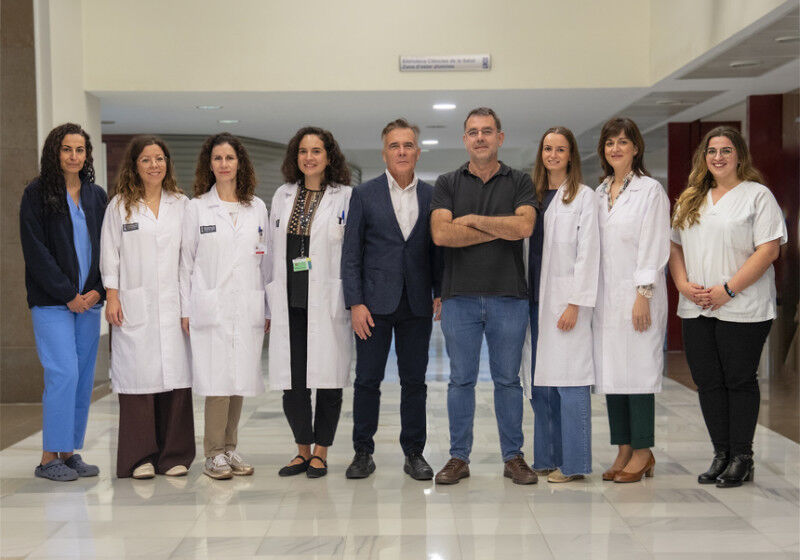
The Universitat has conducted the statistical analysis and machine learning. The study is led by the Haematology Service of the Hospital Clínic and the research groups in Hematopoietic Stem Cell Transplantation and Molecular Microbiology and Microbial Pathogenesis at INCLIVA, with the participation of the Precision Medicine and Bioinformatics Units of INCLIVA, in addition to the UV.
The results, which provide new scientific evidence on the role of the commensal microbiota in the efficiency and safety of CAR-T therapy, have been published in European Journal of Haematology.
According to Dr. Rafael Hernani , member of the Hematopoietic Stem Cell Transplantation Research Group at INCLIVA and the Haematology Service of Hospital Clínic de València, and principal investigator of the study: "Nowadays, the interplay between the commensal flora and the immune system cells is well known and there is strong scientific evidence that associates the presence of some bacteria with a better response to antineoplastic drugs. However, not all bacterial species in the digestive tract play a beneficial role. Some of them, for example, are related to inflammatory bowel diseases or to unsuccessful antitumor treatments. There is hardly any information about the influence of the microbiota on CAR-T therapy. For this reason, our research is focused on which bacteria influence the response to treatment or its toxicity, since it is an essential factor to improve patient prognosis. If, for example, a beneficial species was identified, it may be added as a probiotic to the treatment".
About CAR-T therapy
CAR-T therapy (chimeric antigen receptor T) offers results that significantly improve the efficiency of the conventional cancer treatment and extends these patient’s survival. A CAR-T cell is a lymphocyte (a type of white blood cell of the immune system that recognises and fights infections and cancer cells) that has been genetically modified to specifically recognise a membrane protein (antigen) of the cancer cell.
In order to create CAR-T, the patient must go through an apheresis process using a machine similar to the dialysis one, which filters part of the blood. Once the lymphocytes have been collected, they are sent to the laboratory for the genetic modification process. To this end, the information that will allow to express on its membrane a receptor that specifically and precisely recognises a certain antigen of the cancer cell, is inserted in the lymphocyte’s DNA through a virus.
After finishing the genetic modification process, a number of substances are added to the lymphocytes that will allow them to multiply. When the amount of lymphocytes is enough, they are frozen and returned to the hospital, where they can be infused into the patient, in a process similar to a blood transfusion, requiring only a single administration.
The patient is usually admitted for 10 to 14 days. During this period of time, CAR-T lymphocytes are expected to multiply when they recognise cancer cells and attack them. As a consequence of this fight between the lymphocyte and the cancer cell, some substances, called cytokines, may be released into the blood, and they are responsible for two of the main difficulties of the CAR-T therapy: cytokine release syndrome and neurotoxicity. It is possible that one of these difficulties is developed, causing from a simple fever or headache, to the presence of convulsions or the need to use drugs to increase blood pressure.
After these first weeks, the likelihood of developing these complications is very low, consequently, the patient may be discharged.
A complex study to analyse the microbiota
In this study, faecal samples from 30 patients of Hospital Clínic de València and from healthy co-habitants were collected, using special kits that keep the microbiota unaltered until it is frozen. Bacterial DNA has been extracted and analysed, using shotgun metagenomics sequencing, which allows to identify in detail each bacterial species of the sample. Moreover, in collaboration with Carlos Hernani Morales , researcher at the Universitat de València, studies on machine learning have been conducted to allow the creation of response models by analysing the presence or absence of a small number of bacterial species.
These initial results are expected to serve as a basis to get funding for analysing over 100 patients, whose faecal samples have already been collected. If the number of patients included in the analysis increases, stronger conclusions could be drawn and be more applicable on daily clinical practice. Besides, bacterial metabolic pathways or DNA viruses (intestinal virome), which constitute a hardly studied part of the microbiota, will be analysed.
Article reference: Hernani, R., Albert, E., Hernani-Morales, C., Zùñiga, S., Benzaquén, A., González-Castillo, L., Colomer, E., Morell, J., Català-Senent, J. F., Piñana, J. L., Giménez, E., Pérez, A., Hernández-Boluda, J. C., Arroyo, I., Rivada, M., Barber, T., Alemany, T., Santacatalina, E., Rentero-Garrido, P., Terol, M. J., ... Solano, C. (2026). "Microbiome-Based Modeling of CAR-T Therapy Response in Lymphoma: Insights From Shotgun Metagenomics Sequencing". European journal of haematology, 10.1111/ejh.70121. Advance online publication. https://doi.org/10.1111/ejh.70121