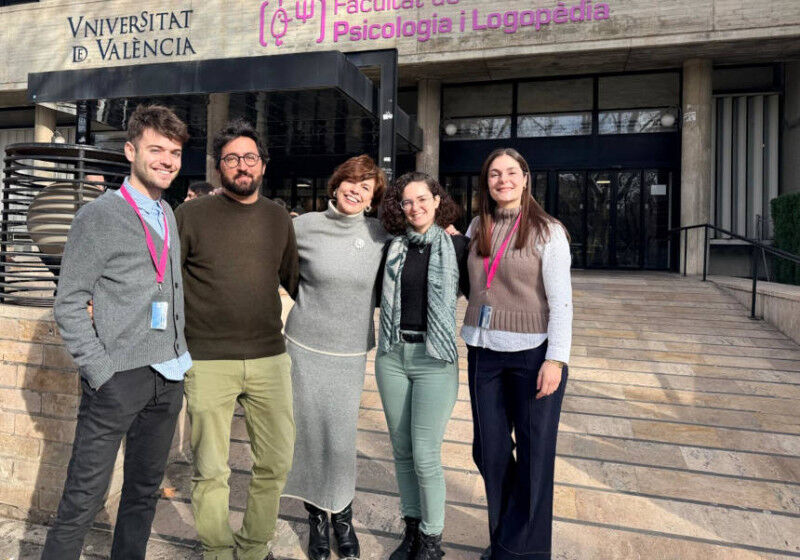
"Do good to feel good". With these words concludes the latest clinical psychology study conducted by the I-PSI-TEC research group , led by professor Ausiàs Cebolla of the Faculty of Psychology and Speech Therapy at the University of Valencia. The findings reinforce a central idea in this field of study: "Everyday actions guided by virtue play a fundamental role in promoting psychological well-being", states the principal investigator.
According to Cebolla, the aim of the research was to determine whether standard interventions in clinical psychology are effective and, furthermore, to understand "how they work".
The results highlight five psychological strengths, three of which emerge as the clearest mechanisms underlying successful targeted (ad hoc) interventions: perspective, understood as the capacity to step back and view problems from a broader standpoint; kindness, encompassing benevolence and compassion - that is, "regarding ourselves and those around us with recognition and acceptance", and gratitude.
"Working specifically on these strengths produces consistent improvements in them and, consequently, in overall psychological well-being. Moreover, they explain why interventions are effective, acting as mechanisms that connect therapeutic activities with a more satisfying life", Cebolla summarises.
The Eudaimonic Model of Well-being
The pattern identified by professor Cebolla supports the eudaimonic model of well-being, defined in psychology as the view that "feeling well does not depend solely on pleasant emotions, but also on living in accordance with values and virtues such as ethics, generosity and practical wisdom, among others".
By contrast, interventions focusing on the other two strengths identified in the analysis - humour and hope - yielded different and "less clear" results. "In these cases, studies did not consistently demonstrate improvements in the specific strength targeted, indicating that further research is needed to refine the design of such programmes", he notes.
A One-Stage Meta-Analysis
According to Ausiàs Cebolla , the study’s conclusions are "particularly useful for designing educational programmes, clinical interventions and public health policies aimed at fostering fuller and more meaningful lives".
To reach these conclusions, the research team conducted an exhaustive analysis of which human strengths are "truly" effective in enhancing well-being, through the statistical review of previous studies.
"Our research is a meta-analysis examining only randomised controlled trials - the most rigorous type of study in science", Cebolla explains. The advanced methodology employed, described as a "one-stage meta-analytic structural equation modelling approach", integrated all’available data. The team screened nearly 84,000 scientific article abstracts, which led to selecting 114 "high-quality" studies, comprising a total of 20,853 participants.
The study received support from the Spanish Ministry of Science and Innovation through the Gatzara project (PID2021-125513NB-100). It was led by the University of Valencia, with professor Ausiàs Cebolla as principal investigator within the I-PSI-TEC research group, and included collaboration from researchers at the Complutense University of Madrid , the Spanish National University of Distance Education (UNED) and the CIBEROBN programme.
Article reference: Ausiàs Cebolla, Belén Fernández-Castilla, Oscar Lecuona, Jéssica Navarro-Siurana, Julieta Galante, Pedro Sarrión, Joana Vidal, Rosa M. Baños, Carmelo Vázquez. "Efficacy of cultivating human strengths and virtues on well-being: A one-stage meta-analytic structural equation modeling approach". Clinical Psychology Review, Volume 124, 2026, 102692, ISSN 0272-7358. https://doi.org/10.1016/j.cpr.2026.102692