


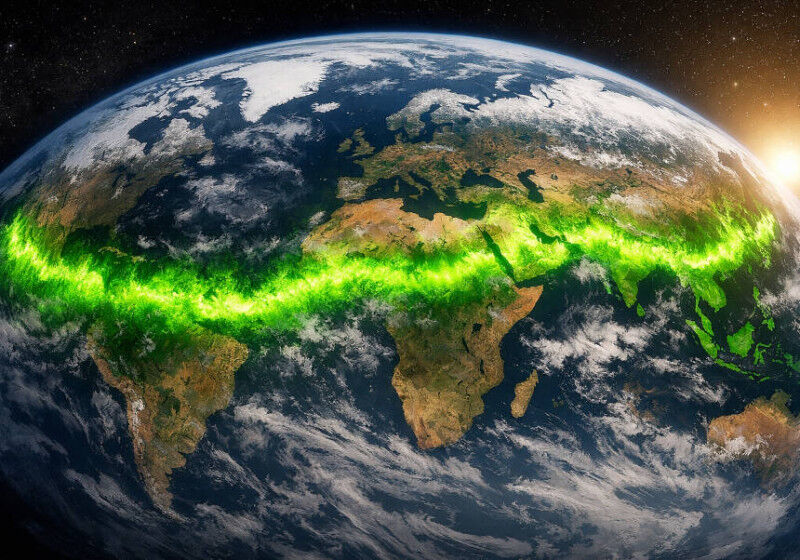
Tracking the Earth’s "Green Heart"
First author Prof. Miguel Mahecha explains: "Imagine holding a perfectly round globe in your hands and attaching small weights to it, each representing the green leaves at every point on the Earth’s surface. If you then carefully place this globe into calm water, the centre of mass will always point downward."
Using satellite observations and model data, the researchers tracked how this "green centre" shifts over time. In rhythm with the seasons, vegetation greenness moves like a green wave from the Northern Hemisphere to the Southern Hemisphere and back each year. By tracking the centre of this wave - its direction and velocity - the team found it oscillating between its northernmost position in mid-July in the North Atlantic near Iceland and its southernmost position off the coast of Liberia in March.
A New Theoretical Frontier
The methodology behind this discovery relies on a novel theoretical framework designed to capture the pulse of the entire planet. Professor Gustau Camps-Valls , from the Universitat de València, who supported the research design and helped develop the underlying theory, sees this as just the beginning. "We’ve essentially compressed the biosphere’s complexity into a single, moving heartbeat," says Camps-Valls. "But this goes far beyond forest health. Our framework can track a ’blue wave’ in the oceans or a ’red wave’ of heatwaves and temperature anomalies. And we’re now exploring a multidimensional tool to monitor the pulse of the entire Earth system."
Why is the Wave Shifting?
The study, published in the journal PNAS, sheds new light on global greening and its acceleration - a less widely known aspect of global change referring to the overall increase in vegetation density worldwide. Like climate change and biodiversity loss, global greening is largely driven by human activities. Rising atmospheric CO2 concentrations act as a fertiliser, enhancing photosynthesis, while higher temperatures extend growing seasons in many regions.
When analysing changes in the green wave over several decades, the researchers detected a consistent northward shift across all seasons. Contrary to their expectations, they did not observe a southward shift during the Southern Hemisphere summer.
In addition to the northward movement, the team also identified a distinct eastward shift. According to the researchers, this pattern is likely linked to pronounced greening hotspots in regions such as India, China, Europe and Russia.
"This was a huge surprise to us," says Mahecha. "Longer growing seasons and warmer winters in the Northern Hemisphere, which allow vegetation to remain slightly greener for longer, may be driving the Earth’s overall greening shift throughout the year. However, this is a hypothesis that we need to explore further."
Tracking the Earth’s seasonal greening like a compass and effectively measuring how fast and in which direction it is changing connects multiple facets of global change, including climate-biosphere interactions,Öland-use change, fire dynamics, droughts, and animal migration. The new method therefore provides a powerful tool for understanding how the living surface of our planet is reorganising in a warming world.
An online guide to the publication is available at: https://greenwave.earth/

