Of the many open questions that baffle physicists today, there is one - the most relevant for cosmologists - that crystallises into a single number: the Hubble constant H0, which represents the ratio between the distance of a cosmic object from us and the speed at which it moves away from us due to the accelerated expansion of the Universe. The puzzle arises from the statistically significant discrepancy between the values of H0 obtained using different measurement strategies: the traditional method, based on the observation of cosmic objects such as Cepheid variable stars and supernovae, and a more indirect approach that uses the cosmic microwave background as a starting point to infer H0.
If this ’Hubble tension’ is real - that is, if the different values of H0 are not caused by systematic uncertainties in measurements that have yet to be identified - it would require a profound rethinking of our understanding of the evolution and composition of the Universe.
In an article published in the journal Astronomy & Astrophysics , the TDCOSMO collaboration documents its latest effort to find an alternative path to accurately measure the Hubble constant. The team’s results support the Hubble tension between H0 measurements of the late and early Universe. Frédéric Courbin, ICREA researcher at the Institute of Cosmos Sciences of the University of Barcelona (ICCUB) and the Institute of Space Studies of Catalonia (IEEC), explains: "To me the lensing time delays is pivotal in the tension resolution as it is fully independent of any other method and as it does not involve complicated calibrations".
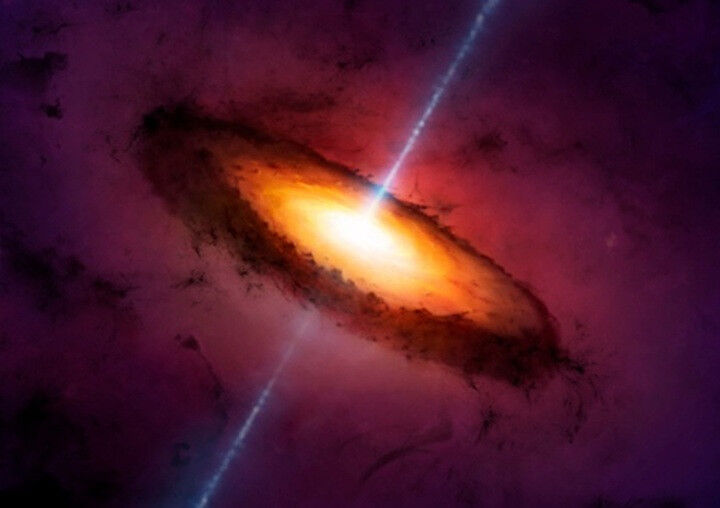
The TDCOSMO collaboration uses a technique known as time-delay cosmography to infer the value of the Hubble constant. In the study, the team applies this method to a sample of cosmic probes known as strongly lensed quasars. A quasar is a distant, extremely bright object produced by an accretion disk of gas and dust falling into a supermassive black hole at the centre of a galaxy.
When a massive object - such as a galaxy - stands between an observer and a quasar, an effect known as gravitational lensing produces multiple images of the quasar.
This is because the so-called lens galaxy - also referred to as the deflector - acts much like an optical lens placed on the path of a light beam: it warps space and, as a result, bends and magnifies the light coming from a background object. In the case of a quasar, the light’s deflection produces bright, distorted lensed images around the lens galaxy.
Crucially, the signature of gravitational lensing on an observed quasar is not only spatial, but also temporal. If the intensity of the radiation emitted by a quasar varies over time, the light rays coming from multiple images of one lensed quasar reach us with temporal delays. Time-delay cosmography allows researchers to measure what is known as time-delay distance. Provided that the gravitational potential of the lens galaxy is sufficiently well known, scientists can infer H0 from the time-delay distance and the light’s redshift caused by the expanding Universe.
To obtain the new value of H0, the TDCOSMO team used previously collected as well as new data on eight strongly lensed quasars, taking advantage of improved analysis methods. For six out of eight lens galaxies, the data related to stellar kinematics were obtained using the NIRSpec spectrograph on the James Webb Space Telescope. Stellar kinematics data refer to the motion of stars in a galaxy: they’re especially important to address a major source of error when determining H0 with time-delay cosmography. Additional data were collected with the Multi Unit Spectroscopic Explorer (MUSE) spectrograph at the Very Large Telescope of the European Southern Observatory (ESO) in Chile and with the Keck Cosmic Web Imager (KCWI) at the Keck Observatory in Hawaii.
The latest findings from the TDCOSMO collaboration highlight the critical role of international research networks and sustained investment in science. Thanks to the support of the Swiss National Science Foundation (SNSF), researchers collected two decades of time-delay measurements of lensed quasars using the Swiss Leonhard Euler Telescope at ESO. This long-term effort was further strengthened by European funding through the ERC Advanced Grant COSMICLENS (PI: Frédéric Courbin).
Highlighting the significance of this research, the European Commission has recently awarded a €12 million Synergy Grant to tackle the Hubble tension through the RedH0T project, co-led by researchers Licia Verde (ICREA-ICCUB) and Frédéric Courbin.
Reference article:
Birrer, Simon et al. « TDCOSMO 2025: Cosmological constraints from strong lensing time delays ». Astronomy & Astrophysics, November 2025. DOI: 10.1051/0004-6361/202555801.