Digital art piece made with the Stable Diffusion algorithm showing neurons expressing Unc5 (in green) over radial glia fibres expressing GPC3 (in blue).
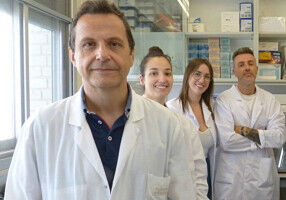
Digital art piece made with the Stable Diffusion algorithm showing neurons expressing Unc5 ( in green ) over radial glia fibres expressing GPC3 ( in blue ) . During brain development, neurons have to migrate long distances through complex environments until they reach their final destination. In order to find guidance, they must establish several interactions —which are still hard to study— between their receptors and the surrounding molecules. Now, a paper published in the prestigious journal Cell has identified how two different proteins, the neuronal receptor Unc5 and the molecule Glipican 3 (GPC3), collaborate decisively in the guidance of neurons in two different processes: brain formation and the propagation of brain-derived cancer cells (neuroblastoma). The paper identifies the spots where both proteins connect, it reveals the structure of the new Unc5-GPC3 complex and it determines its key role in neuron migration and certain tumours. It also delves into the mechanisms that regulate cell migration in a precise way, and it states how some molecular mechanisms that regulate cell migration are highly conserved between neurons and some brain tumours. The team that led the study is formed by the experts Daniel del Toro, from the Faculty of Medicine and Health Sciences and the Institute of Neurosciences ( UBNeuro ) of the University of Barcelona, the August Pi i Sunyer Biomedical Research Institute (IRIBAPS) and the Biomedical Research Networking Center on Neurodegenerative Diseases (CIBERNED); Valerie Castellani, from the University of Lyon (France) and Elena Seiradake, from the University of Oxford (United Kingdom).
TO READ THIS ARTICLE, CREATE YOUR ACCOUNT
And extend your reading, free of charge and with no commitment.