


Humanities - History & Archeology
Social networks spanning thousands of square kilometres during the Upper Palaeolithic period

Study reveals social networks spanning thousands of square kilometres during the Upper Palaeolithic period - The study, based on the geochemical analysis of knapped stone tools, shows that hunter-gatherers in the center of the Iberian Peninsula maintained long-distance contacts, covering large areas of Western Europe.
A literary tour in the Historic Building
On the occasion of its 575th anniversary, the University of Barcelona is offering a series of guided tours to explore the interesting and prolific connection between its iconic headquarters and literature.
The victims of the Pompeii eruption wore heavy wool cloaks and tunics, suggesting different environmental conditions in summer
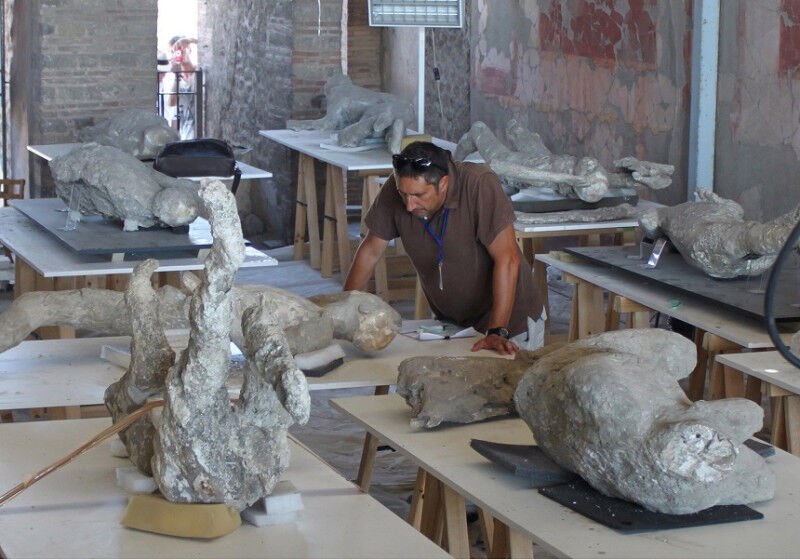
The ÁTROPOS research group on the culture of death at the University of Valencia (UV), based on the analysis of fourteen casts from Pompeii, has concluded that both indoors and outdoors, the victims
First in situ analysis of Mediterranean rock art using a non-invasive method combining smartphones and portable X-ray fluorescence

Researchers from the University of Valencia (UV) and the French National Centre for Scientific Research (CNRS), among other research centres, have for the first time analysed Mediterranean cave art in situ using a technique that combines the use of smartphones and a portable X-ray fluorescence device, at the archaeological site of Cocó de la Gralla (Mas de Barberans, Tarragona).
Oldest hippopotamus ivory object in the Iberian Peninsula
The discovery opens up new perspectives for the study of exchange networks in the Mediterranean during the Copper Age. Archeology Researchers at the Prehistoric Studies and Research Seminar (SERP) of the University of Barcelona have identified the oldest piece made of hippopotamus ivory in the Iberian Peninsula.


